May 11, 2026

Article by
Sarah-Maude Plante - Director, Experiential Strategy
How do corporate events benefit your company?
So, you plan corporate events. They’re well executed, well attended, everyone enjoys them, and the final results are satisfying.
Great. But deep down, what are you really trying to achieve? Is your goal to make people happy, or to make your brand stand out?
Because an event can be highly enjoyable in the moment, without leaving a lasting impression. Did your guests have fun? Yes. But after that, what’s left?
What has your event actually accomplished in terms of your company’s goals, beyond the usual metrics?
Were the anticipated benefits clearly defined from the outset?
An event should always have a tangible impact. It should influence how your message is understood, shape perceptions of your priorities, and send a clear signal about your leadership. Whatever your goal, it should be carefully considered, planned and intentionally included in both the design and implementation of the event.
When an event has a clear purpose, it can reinforce what traditional channels can’t convey on their own.
Your events could be doing more for your organization. Let’s chat.
Opening a new channel
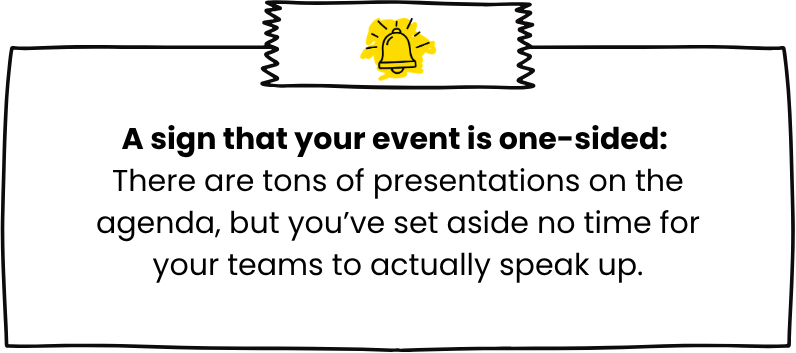
In day-to-day operations, corporate communication is often top-down. A well-planned event helps spread your message more effectively. For senior management, this is a rare opportunity to get a true sense of the situation. But you can’t just wing it.
You need to make concrete decisions: how much time to allocate to discussions, how to structure the speaking segments, the posture your leaders should adopt, and so on. And it all should be done in a fun and enjoyable way. Without these choices, the event remains superficial. With them, it becomes a catalyst.
Giving meaning to your actions
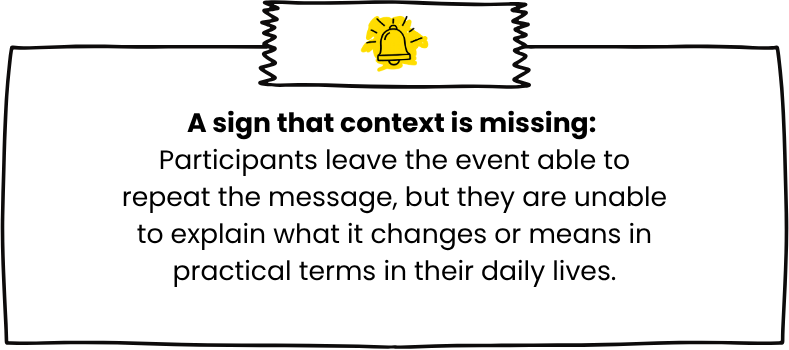
Sending a message is easy. The hard part is predicting how it will be interpreted, perceived, remembered, shared, and, above all, put into practice. Your event should give you a certain degree of control over all these factors.
At Bob, our goal is to influence how your message shapes what happens next, starting the next day. Planning what is said, by whom, in what order, and in what context—while clarifying the meaning you want to convey through your actions—reduces ambiguity and points the way forward.
Designing interactions that matter
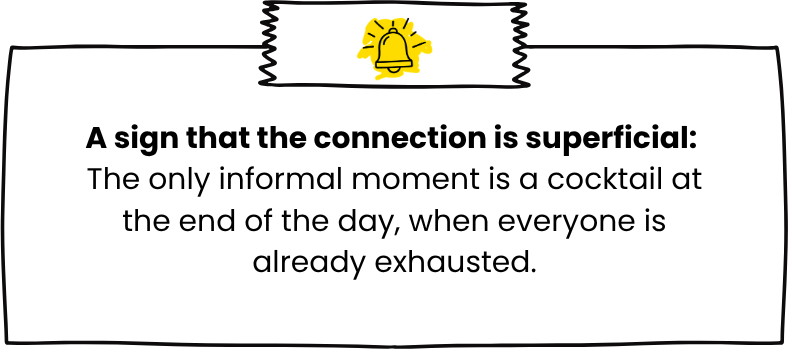
A strategic event can also help rebuild relationships by providing the value of shared time, genuine attention and interactions that go beyond mere execution. Forget about forced camaraderie or superficial team-building activities. It’s a question of experience design.
The space, the pace and the interactions that the event facilitates determine whether people leave having formed a genuine connection or having simply been present in the same room.
Highlighting consistency (or the lack thereof)
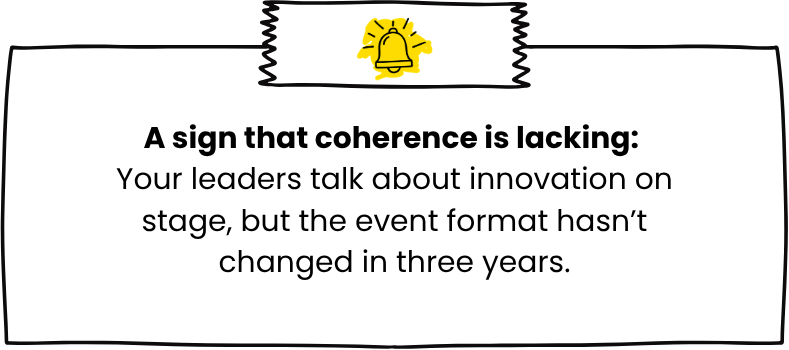
Oftentimes, an event puts a company’s coherence to the test. It amplifies both what is aligned and what is not. It’s up to you to decide what you want to highlight.
Events influence a company’s perceptions and dynamics more than you may think. The difference between an event that “went well” and one that truly makes a difference comes down to two things: the ambition behind it and the rigour with which the ambition is reflected in every design decision.
This work can be completed during the project’s launch phase. It can also be included once the project is already underway to clarify, mediate or refocus it.
If you see untapped potential for corporate impact in your events, we should talk.